
Why We Fight
The impasse over Obamacare premium subsidies wouldn't be necessary in a saner system.


Since Obamacare’s enhanced premium subsidies are at the heart of the congressional impasse partly resolved by last night’s Senate vote, it’s worth recalling why subsidies exist at all. In short, they were politically the only way to expand coverage to a few million people, mostly in the non-group market, and pare down the 15% of Americans who were uninsured. That was Obamacare’s rather modest objective. The subsidies are therefore essentially a creation of the health-insurance lobby, abetted mostly by Republicans, who have refined the art of creating problems that they can turn around and bitch about.
Both Donald Trump and Barack Obama are on the record as having favored a single-payer system — Trump at least for five minutes after he heard it explained. But the insurance industry objected to public options that might have gotten a fair hearing during the debate over what became the Affordable Care Act, better known as Obamacare. Comprehensive, universal coverage — like that in every other industrialized country — was off the table in 2009 because key lawmakers, like Senate Finance Committee Chairman Max Baucus, kept it off the table.
The next best option was to pay private insurers to do what they otherwise wouldn’t do: cover the medically uninsurable (people insurers can’t cover profitably for any premium customers can afford to pay). Even Donald Trump recognizes how absurd this is. He has called the subsidies to “money-sucking” insurers a “bailout” — not really an accurate description of an industry that isn’t exactly bankrupt, but close enough for Trump.
Problem is, Republicans had their chance to repeal and replace in 2017 but made relatively trivial modifications, leaving subsidies in place. Turns out insurers have done rather nicely under Obamacare, which, says the Paragon Health Institute, has “turned the unsubsidized individual market into a market with much higher premiums that people typically need massive subsidies to afford. These subsidies give insurers significant pricing power as the burden of premium increases over time is almost entirely borne by taxpayers.”
Of course, premium subsidies would not be required at all in a system of universal access, which can be achieved in several ways. One is outright nationalization of healthcare, as with the UK’s National Health Service. Easily exploited fears of “socialized medicine” make this impossible, even though we already take that approach with veterans, active-duty military personnel and other groups.
Another is single-payer, meaning government as the sole insurer. We have that too, in the form of Medicare.
Still another is a regulated private insurance market (the “Bismarck model” adopted by Germany and Japan, among others) that mandates participation and requires insurers to cover everyone. In this country, government already subsidizes virtually all healthcare. If the enhanced subsidies survive, there are ways to constrain those costs, too.
The market speaks
But the idea of universal, government-mandated coverage has always been kryptonite to private insurers. If common sense doesn’t tell you this, stock prices should. Insurance shares surged the day after the 2020 Super Tuesday primary, because winner Joe Biden backed modifications to Obamacare that were less threatening to profits than the single-payer system backed by loser Bernie Sanders. They likewise sank yesterday when Trump suggested paying the subsidies directly to Obamacare participants instead of routing them through private insurers.
It can’t be stated too often that the profit interests of private insurers are in direct conflict with the health interests of everyone else. Their lobbying power keeps them at the lucrative center of healthcare, extracting a cut of every medical transaction and adding net cost, not value. (This is why Obamacare imposes “minimum medical loss ratios,” which limit the proportion of premium income that goes to administration and profit.) Insurers defend their interests tooth-and-nail, which is why there is no universal care in this country, which is why the subsidies are a necessary if distasteful approach, which is why the prolonged government shutdown.
It’s easy to find fault with Obamacare, but it’s just as easy to fault any alternative plan. Single-payer systems broaden access, but generally at the cost of longer wait times for elective procedures. Mandated participation improves the risk pool, but imposes costs that many regard as coercive. And so on. Perfection is an unreasonable standard here. If it were possible to build a system that covered everyone with no painful trade-offs, it would have been done already.
Jonathan Chait and Elizabeth Warren call Sunday’s capitulation by eight defecting Democrats a “mistake.” A better word would be “cowardice” — unless it’s a clever ploy to force the installation of Democratic Rep.-elect Adelita Grijalva and secure a vote on releasing the Epstein files. (Good if belated news: Speaker Mike Johnson has apparently decided to do his job; she could be sworn in this week.)
Democratic leader Chuck Schumer apparently encouraged the surrender behind the scenes, then voted against the compromise, writes The American Prospect’s Robert Kuttner, “in the hope that his vote would conceal his fingerprints. He fooled no one.”
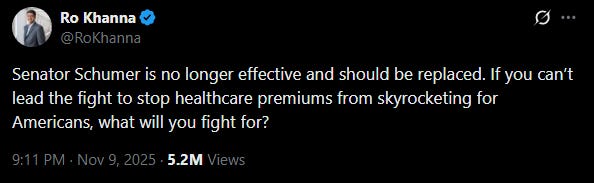
Democrats who think they’ve won some sort of concession need to read the fine print. What they’ve “won” is the Republican promise of a Senate vote on the tax credits within 40 days in return for a two-month re-opening of the government. There was no commitment on a House vote, and it would be surprising if Johnson even allows it onto the floor. In any event, Democrats would almost certainly lose either vote, which at least would put the blame for the coming healthcare calamity squarely in the Republican court, where it belongs.
Deleveraged
For now, Democrats have sacrificed whatever leverage they might have gotten to extend the expanded tax credits. As Connecticut Sen. Chris Murphy noted on the PBS News Hour Monday, the pain of higher healthcare premiums is only now becoming apparent to many, and “the pressure was going to mount on Donald Trump and Republicans over the next few days and weeks to do something about this oncoming catastrophe…” A silver lining if Republicans succeed in killing the expanded credits: They could pay a hefty political price.
To be sure, those eight Democrats — none of whom faces reelection anytime soon—had their reasons. “We had no path forward on healthcare because the Republicans said, ‘We will not talk about health care with the government shut down,’” said Virginia Democrat Tim Kaine, one of the eight, “and we had SNAP beneficiaries and those relying on other important services who were losing benefits because of the shutdown.”
Takeaway: Extortion works.
A question for “moderate” Democrats: When are you going to realize that we are no longer playing politics between the 40-yard lines? The game has left the field and is out in the parking lot. The Republicans have brought stilettos and broken beer bottles to this rumble. The eight Democratic defectors are carrying white flags and appealing to sweet reason. We all know who’s ultimately to blame for this: the folks that the reliably spot-on Charles Pierce calls “the party of psychopathic goons and their enablers.”
In MAGA world, regrettably, psychopathic goonery is a pre-existing condition.
Excellent article! Another family physician and I have ideas on how the US could organize evidence-based community collaboratives for primary care to let consumers decide this issue and stably direct the market gradually to what we prefer by allowing us all to apply stipends, premiums or employer and retirement benefits to our choice of primary care practices and our choice of catastrophic insurance plans for hospital and specialty treatments for which actuarial science can determine fair pricing.